
Building a new open policy development platform dedicated to cultural devolution….
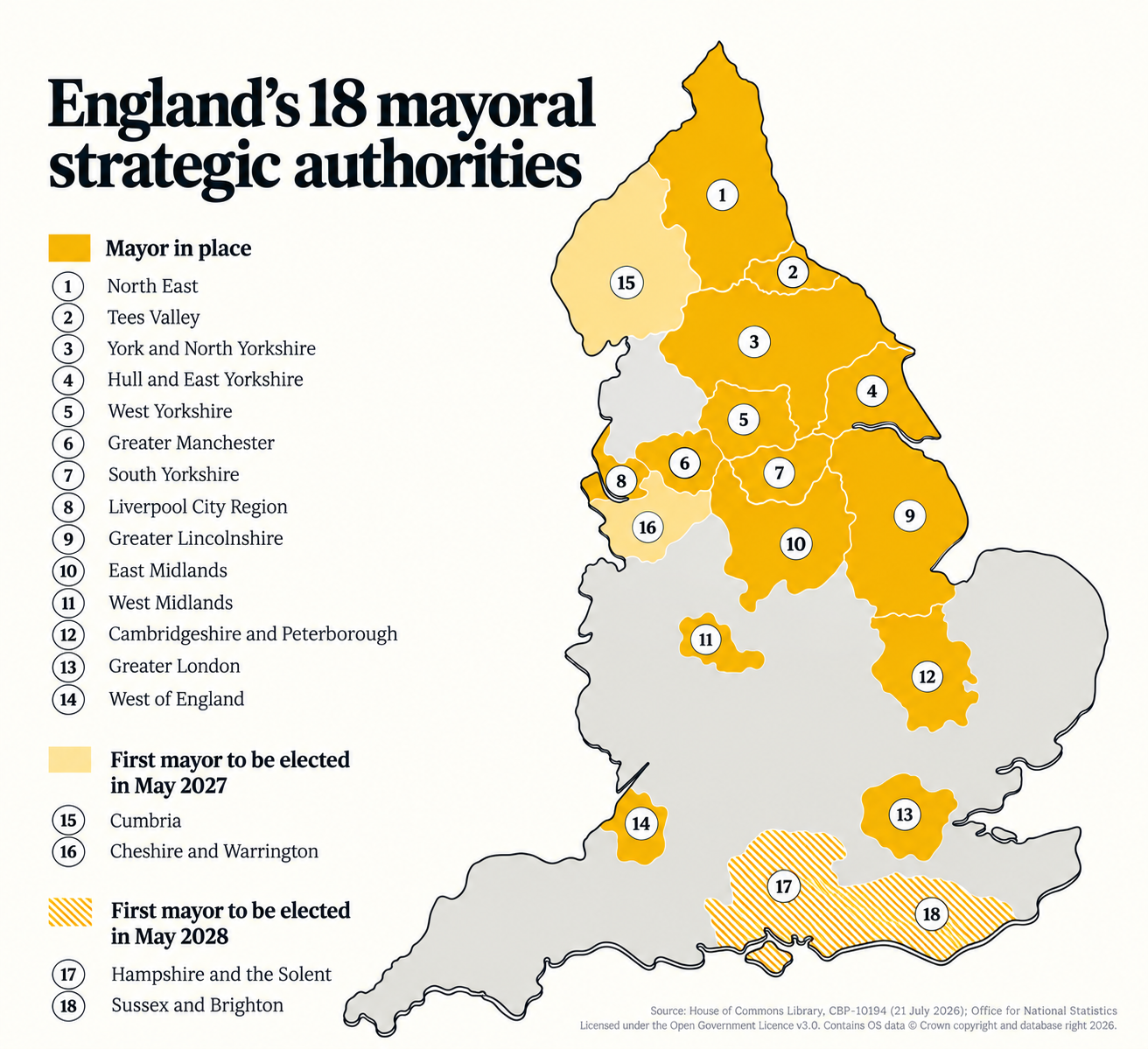
In 2026, Culture Commons secured culture as an eighth area of competence within the UK Government’s flagship English Devolution & Community Empowerment Act.
In response to Culture Commons work in 2o26…
“We need a more devolved model of culture in this country.”
Andy Burnham MP

The plan
For the first time, sub-regional leaders and the communities they serve in England have a legislatively backed mandate to act in the interests of the creative, cultural and heritage life of their areas.
It’s a significant shifts in cultural policy and the implications for our sectors and different places across England could be considerable.
The opportunity on the table now is to help shape how the new competence for culture is brought to life to support regional governance, investment and public policy.
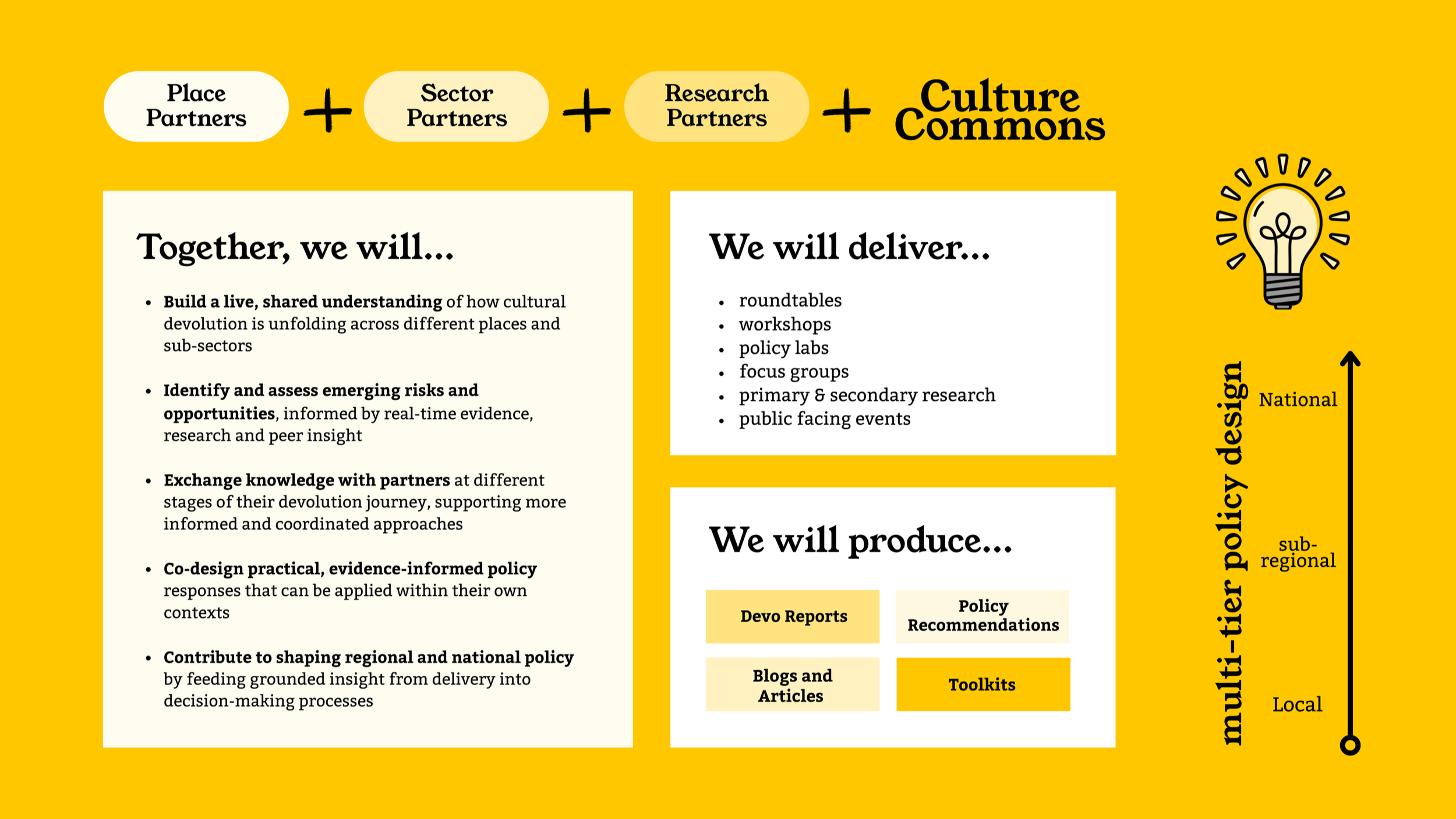
That’s why we’re convening a consortium of places, sector bodies and research institutions to develop an independent and inclusive new open policy development platform dedicated to cultural devolution.
We’re inviting a range of stakeholders from right across the creative, cultural and heritage ecosystem to join us:
Strategic authorities will gain a more structured programme to help explore new cultural powers with confidence, align culture with wider policy priorities and be part of a shared platform for collective national advocacy on issues of shared interest.
Local authorities will be able to play a defining role in shaping new sub-regional approaches, ensuring that local delivery, assets and expertise are reflected in how devolved systems operate.
Research institutions will contribute to the growing evidence base underpinning cultural devolution, bringing methodological expertise, analytical capacity and independent insight to support evidence-led policy design, testing and evaluation.
Sub-sector representatives will be able to influence how devolved policy develops in practice, reducing fragmentation and strengthening their own national networks and infrastructures they rely on.
Arm’s-length bodies, funders and support organisations will be able to shape how investment frameworks, expertise and national infrastructure align with evolving place-based leadership whilst helping areas to maintain the arm’s length principle.
Emerging work strands
-
![]()
Decision-making
How should decision-making work in a more devolved cultural system? And what models of shared governance can support meaningful participation across the ecosystem and maintain the arm’s length principle?
-
![]()
Strategic planning
How should priorities, investment and cultural infrastructure be coordinated across a more devolved system? What tier of governance should plan for what?
-
![]()
Financing
What financing models could best support a stronger, fairer and more resilient cultural ecosystem within a new devolved system?
-
![]()
Cultural Rights
How might devolution help local people and the cultural sector to protect and exercise Cultural Rights at the sub-regional scale?
-
![]()
Data
How can data be improved to support a clearer, more consistent understanding of the cultural ecosystem and enable better decision-making across different spatial scales?
-
![]()
Climate resilience
How can cultural devolution strengthen climate resilience through better alignment between local and strategic government?
-
![]()
Your work strand here?
What questions are you, your organisation or your network asking about cultural devolution?







The objectives
Devolution is ultimately about the redistribution of power and decision making. But unless that transition is shaped deliberately, it risks simply relocating existing inequalities rather than addressing them.
The new policy platform we’re developing will provide an open and independent space where governments, our sectors, researchers and communities can work together to ensure new powers, investment and institutions create a more equitable, resilient and effective cultural ecosystem.
-
An independent platform where researchers, policymakers, Strategic Authorities, local government and the wider cultural ecosystem work together on live policy challenges as they emerge.
-
Translate research into practical policy, test new models and support the implementation of devolved powers through real-world collaboration.
-
Help ensure cultural devolution reduces, rather than reinforces, geographic and socio-economic inequalities by connecting decisions across places, sectors and tiers of government.
-
Bring together places, communities, practitioners and national institutions so that lived experience informs policy, and national policy responds to local realities.
-
Reduce duplication, share learning and create common tools that help places develop together rather than compete or work in isolation.
-
Provide trusted, not-for-profit convening, open knowledge and shared problem-solving designed to strengthen the whole cultural ecosystem.
-
Experiment with new approaches while devolution is still taking shape, generating evidence and early wins that influence the long-term settlement.
Why now?
-
England’s system of devolution is fundamentally reshaping where decisions about places are made. Strategic Authorities are assuming new responsibilities for economic development, transport, housing, skills and regeneration, while local government is itself being reorganised. For the first time in a generation, there is a genuine opportunity to rethink how the creative industries, culture and heritage are governed, funded and supported.
-
Our research suggests that the current system remains fragmented. Responsibilities, funding and accountability are spread across multiple institutions operating at different spatial scales, often without a coherent framework connecting national ambition with local delivery. At the same time, many local authorities and sector bodies are expected to sustain cultural ecosystems without the powers, capacity or long-term investment needed to do so effectively.
-
Devolution creates opportunities, but good outcomes are not inevitable. Without shared evidence, collaboration and practical experimentation, new arrangements risk reinforcing existing inequalities, creating uneven capacity between places and embedding governance models that prove difficult to change later. The decisions being made over the next few years will influence where power, investment and responsibility sit for decades to come.
-
Drawing on Culture Commons’ research and policy development programme, the Think & Do Tank provides an independent, collaborative space where government, researchers, practitioners, funders and communities can work together to develop, test and refine solutions as devolution unfolds. Rather than producing static recommendations, it supports an iterative process of evidence gathering, policy development and implementation, helping ensure England’s emerging cultural governance system is more equitable, resilient and effective.
When it comes to cultural devolution, we’re already had real-world impact
✅ Secured ‘culture’ as a formal area of competence within the English Devolution and Community Empowerment Bill, strengthening our sectors place at the table.
✅ Influenced national housing policy through the New Towns Taskforce, embedding minimum levels of cultural infrastructure for the future of new communities.
✅ Informed Baroness Margaret Hodge’s much anticipated review of Arts Council England, helping to shape the future role of arm’s-length bodies.
✅ Contributed to DCMS’s Culture & Heritage Capitals programme, recalibrating the way cultural investments are valued within HM Treasury’s Green Book methodology.
✅ Supported mayoral combined authorities to shape and secure enhanced devolution plans for culture, opening an additional layer of advocacy for our sectors.
✅ Part of a consortium of partners developing a blueprint for a National Cultural Data Observatory, which will support data-informed devolved cultural decision making.
Always evidence-informed…
In 2024, Culture Commons launched The Future of Cultural Devolution in the UK.
This year-long programme of research, insight gathering and open policy development brought together 30 core partners, six universities, 25 researchers, over 250 cultural organisations, the creative workforce (including freelancers) and the public.
Together we developed research projects on a range of key strategic questions related to cultural devolution. The findings represent the largest evidence base on cultural devolution assembled anywhere in the world.
We used it to rigorously assess the risks and opportunities of deepening and widening cultural devolution across the UK. It was used to underpin the development of a suite of policy proposals for the English Devolution and Community Empowerment Act.
Project Publications
Scroll for more publications…
























Get In Touch
If you or your organisation would like to come and be part of this new emergent policy platform for cultural devolution, please get in touch with us at contact@culturecommons.uk